
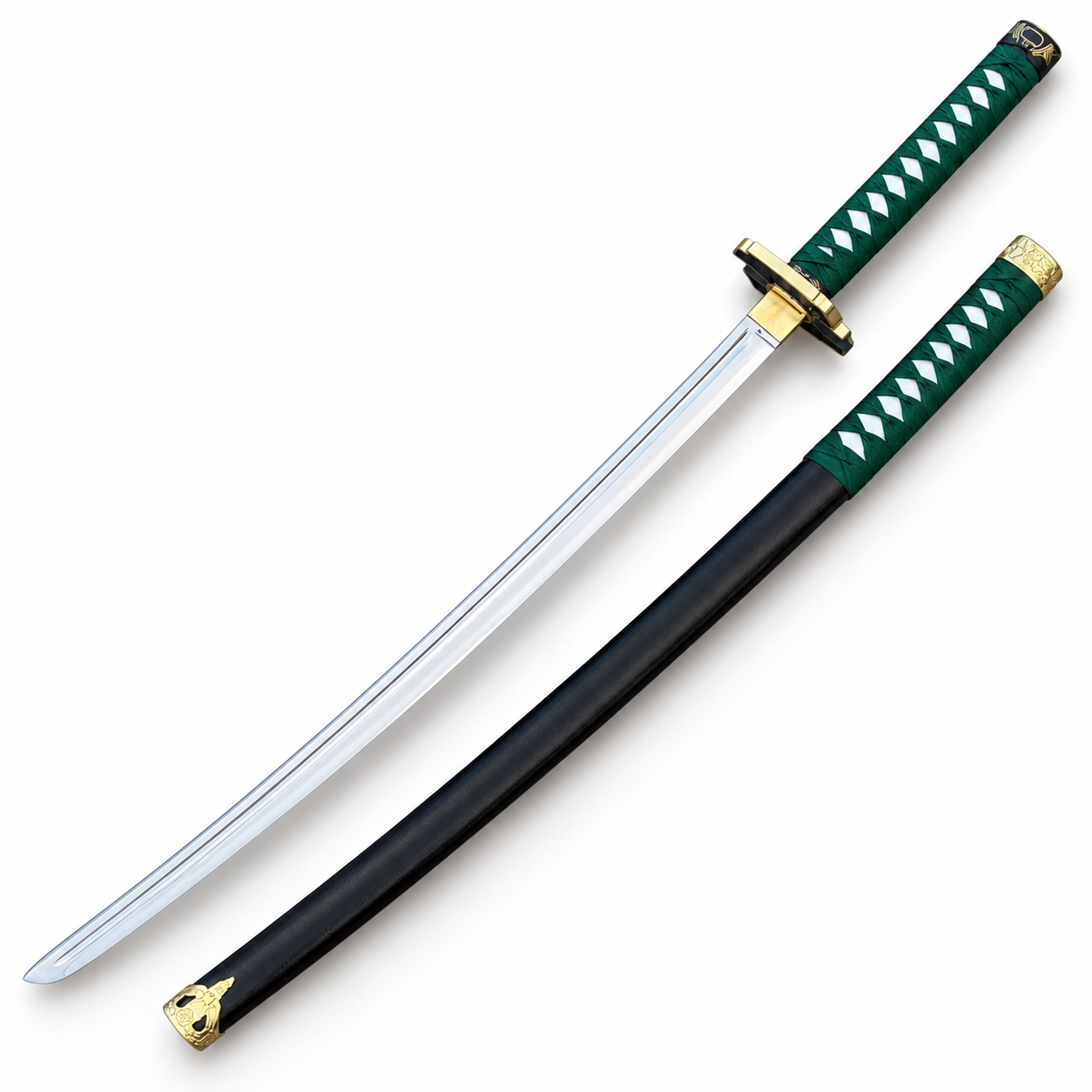
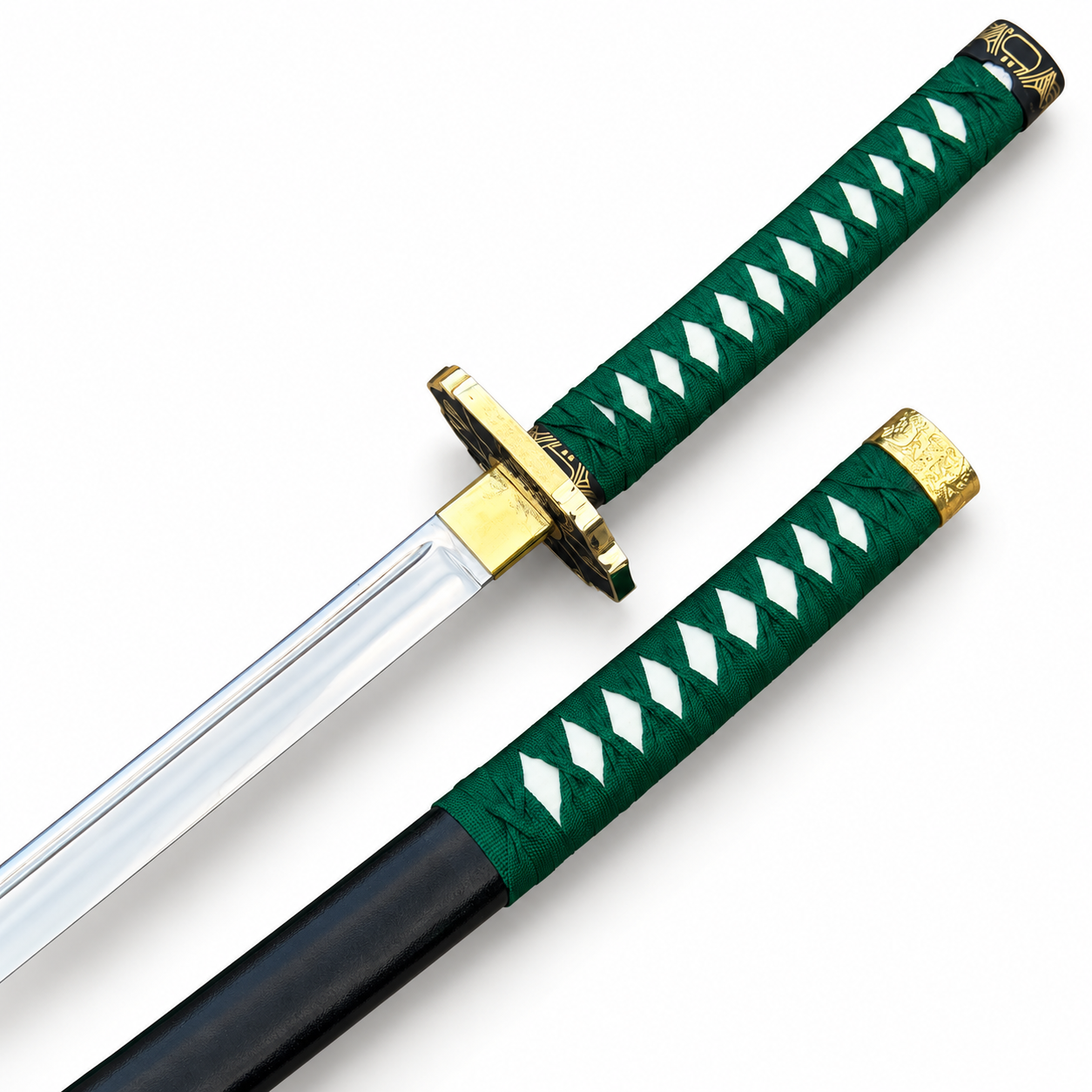
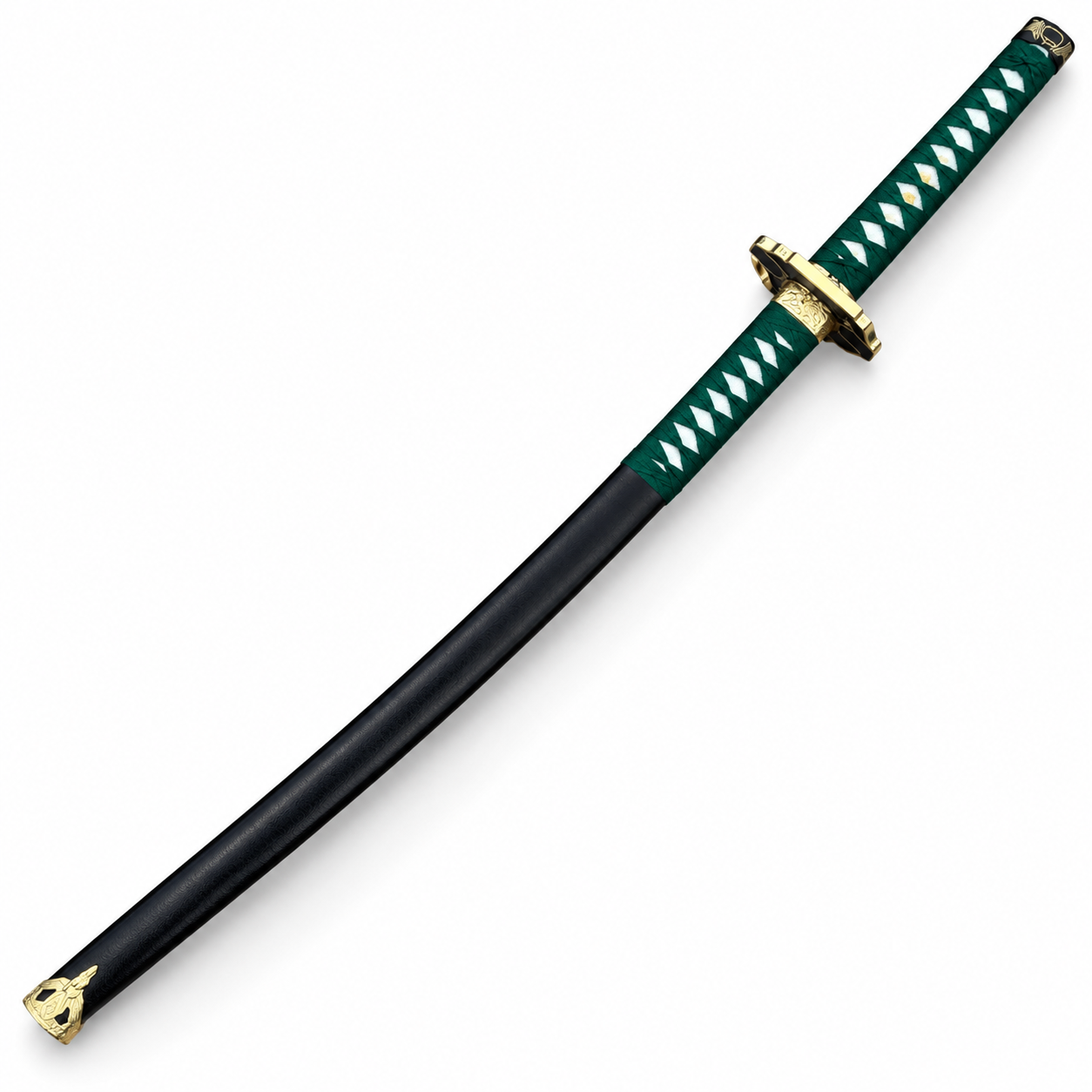
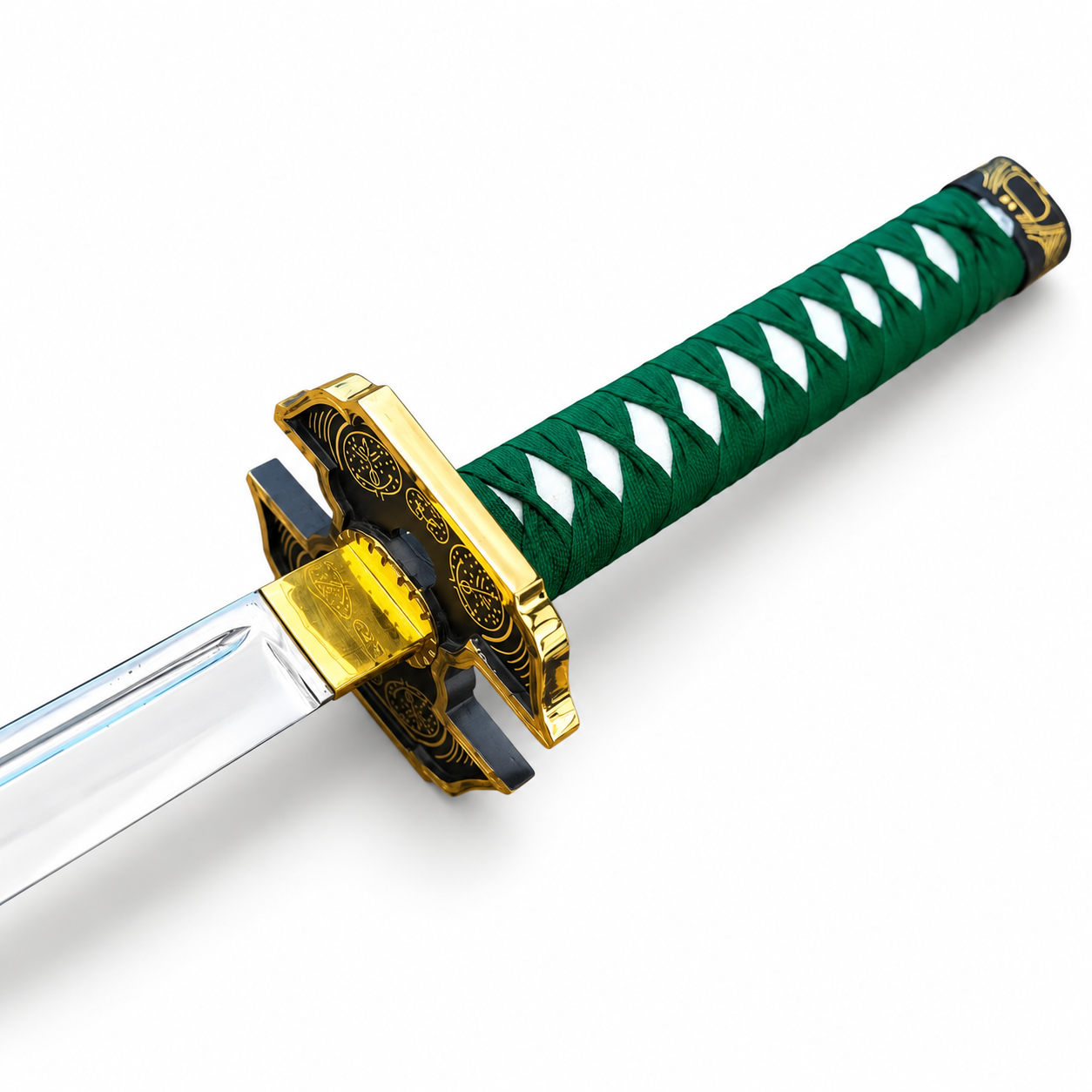
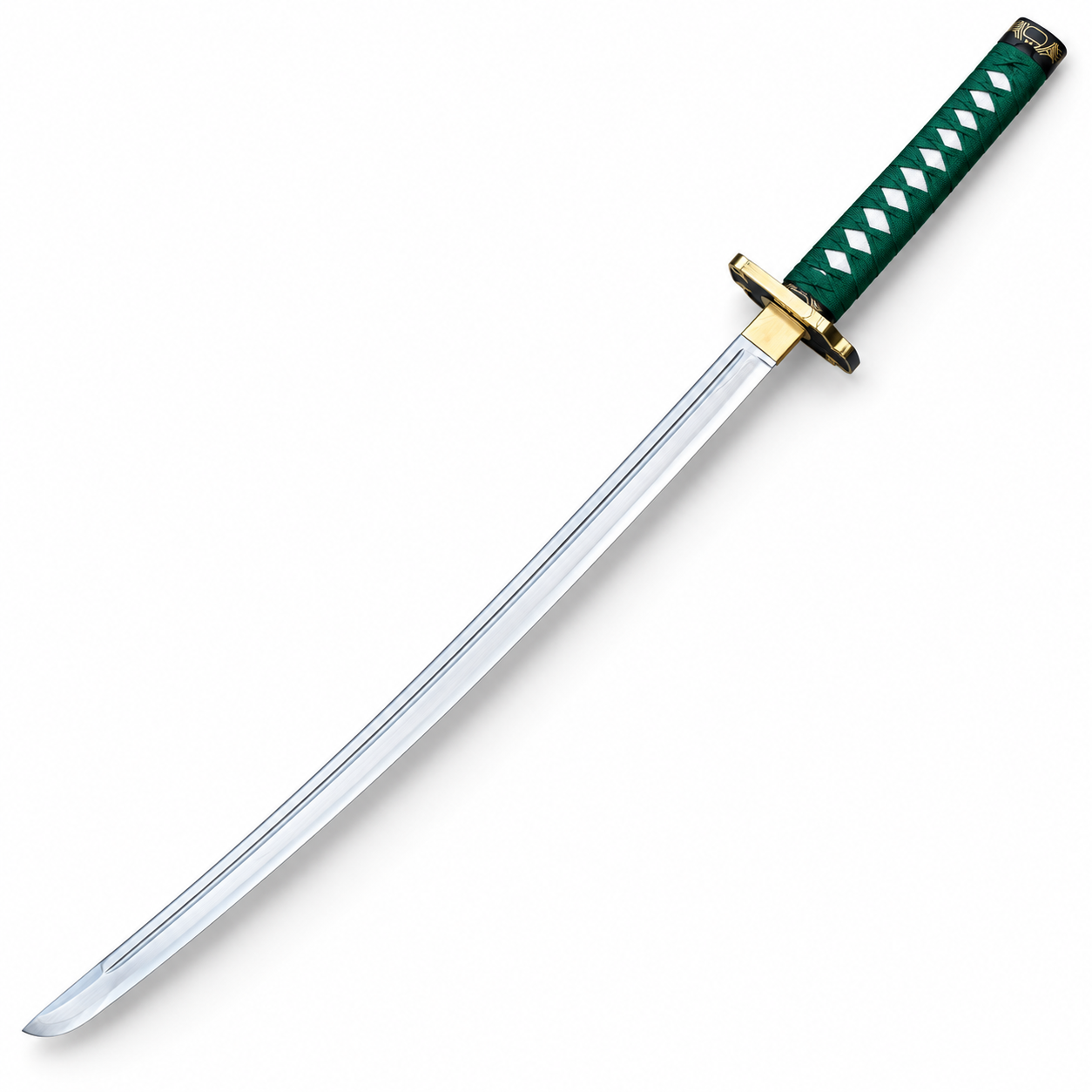
Emerald green katana sword with white diamond-pattern handle, polished blade, gold fittings, and black scabbard on a white background.
Discover an eye-catching Japanese-style katana featuring an emerald-green handle with white diamond-pattern accents, a polished silver-tone blade, and elegant gold-and-black fittings. The matching black scabbard completes the coordinated design.
Designed for adult collectors and enthusiasts of Japanese-inspired swords, this katana combines contrasting colors with decorative details for an attractive addition to a collection or display.
Product Features
- Product type: Japanese-style katana sword
- Handle color: Emerald green with white diamond accents
- Blade finish: Polished silver-tone appearance
- Guard: Gold-and-black decorative design
- Scabbard: Black with coordinated decorative fittings
- Style: Traditional Japanese-inspired design
- Suitable for: Adult collectors and decorative displays
Why Choose This Katana?
- Distinctive white, black, and gold color combination
- Detailed decorative guard and fittings
- Reflective blade finish with a visually striking pattern
- Suitable for Japanese sword-style collections and themed displays
- A distinctive gift idea for adult collectors and enthusiasts
Specifications
- Overall Length: 39 inches
- Blade Length: 29 inches
- Blade Material: J2 steel
- Handle Material: Emerald green with white diamond accents
- Sheath Included: scabbard
History of the Katana
The katana emerged in Japan during the late Kamakura period (around the 13th to 14th centuries), evolving from earlier, more deeply curved swords such as the tachi. As samurai shifted toward fighting on foot, swordsmiths developed a blade that could be worn edge-up through the belt and drawn and cut in a single motion, which became the defining trait of the katana.
Japanese swordsmiths refined a distinctive forging tradition over centuries. Working with tamahagane steel produced in clay tatara furnaces, smiths folded and forge-welded the steel to refine it, then used differential hardening, the clay-tempering technique, to create a hard cutting edge and a more resilient spine. This same process produces the hamon, the wavy temper line prized as a mark of a traditionally made blade.
During the peace of the Edo period (1603 to 1868), the katana became as much a symbol of samurai rank, identity, and honor as a practical sword, often paired with a shorter blade (the wakizashi) in a set known as the daishō. After the samurai class was formally dissolved in the late 19th century, the katana endured as one of the most revered objects in Japanese culture, and the craft of Japanese swordsmithing is recognized and preserved as a traditional art to this day.
This katana carries that lineage forward in its form: the curved single-edged blade, the clay-tempered edge and hamon, the full tang, and the wood handle and sheath that define the classic samurai sword.
Safety Notice: This is a sword-style product. Keep it securely stored and out of reach of children. Buyers are responsible for checking applicable age restrictions, shipping rules, and local laws before purchasing.
explor more here https://arknivesindustry.com/


Reviews
There are no reviews yet.